Skip to content
Onigiri Packaging Solution
I.Background and Market Analysis
1.1 Background
Onigiri, as a popular Japanese-style portable staple food, has been gaining increasing popularity in the Russian ready-to-eat food market in recent years. With its advantages of convenience, portion control, and attractive appearance, Onigiri has become particularly favored by urban young consumers and office workers.
Despite the continuous growth of market demand, more than 95% of Onigiri products in the Russian market are still produced manually, which limits the potential for large-scale production and standardized quality control.
The customer of this solution is located in Saint Petersburg and is one of the most representative Onigiri manufacturers in Russia. To respond to the growing market demand and optimize labor costs, the customer plans to upgrade the existing manual production process into an automated Onigiri Packaging Solution while maintaining its unique product structure and texture requirements.
1.2 Requirements
The customer has proposed the following key requirements for this solution, aiming to improve mass production efficiency while ensuring product consistency and quality standards:
(1) Automation of Key Processes
To automate critical operations, including Onigiri forming, seaweed wrapping, and automatic labeling, thereby replacing existing manual processes and improving overall production efficiency.
(2) Adaptation to Non-standard Product Dimensions
The Onigiri features longer side lengths and a thinner thickness compared with conventional triangular rice balls available in other markets. Therefore, customized forming molds and a flexible pressing system are required to meet the unique product specifications.
(3) Handling of High-fluidity Fillings
The filling material has a relatively soft, fluid texture that may overflow during pressing. Structural optimization is required to ensure stable forming performance while maintaining product integrity and visual appearance.
(4) Increased Production Capacity
To achieve high-frequency and stable production, meeting future order growth and expanding market demand.
(5) Maintaining Product Appearance and Retail Compliance
To ensure the Onigiri maintains a full and attractive shape, accurate label positioning, and overall packaging quality that meets supermarket retail standards.
(6) Support for Multi-flavor Expansion
The solution should provide sufficient flexibility to accommodate future product variations, including different flavors and package specifications.
1.3 Approach
To address the customer’s key requirements in terms of automation capability, product structure adaptation, filling control, and future market expansion, we have developed a comprehensive automated Onigiri production solution based on the design principles of high functional compatibility, precise process control, and flexible modular expansion.
The main strategies include:
(1) Introducing Key Automation Equipment to Improve Continuous Production Capability
The key processes, including forming, filling, packaging, and labeling, will be fully automated. By integrating a dual-station Onigiri forming machine, automatic filling machine, Onigiri packaging machine, and double-sided labeling machine, the solution enables a fully mechanized production process, effectively improving production efficiency, reducing manual errors, and lowering labor costs.
(2) Customized Upper and Lower Split Forming Process for Thin and Lightweight Onigiri Structure
Considering the customer’s unique Onigiri dimensions, the solution adopts customized forming molds, a servo-controlled pressing system, and a segmented pressing strategy. Two forming machines are configured to independently complete the bottom layer forming and top layer covering processes. This allows precise control of pressure and pressing time at each stage, ensuring complete shaping, structural stability, and a full appearance without deformation or collapse.
(3) Rotary Pump Filling System for Stable Handling of High-fluidity Fillings
The rotary pump filling system, combined with bottom-layer groove design and soft pressing control technology, enables precise and consistent filling of high-fluidity sauces while effectively preventing overflow and improving product quality and appearance. A manual filling station is also reserved to handle special fillings, enhancing production flexibility.
(4) Increased Production Capacity to Support Market Expansion
While maintaining cost efficiency and a compact footprint, the complete line is designed to achieve a standard production capacity of ≥1,500 pieces/hour, providing reliable, efficient, and continuous industrial-scale operation.
(5) Ensuring Retail Appearance and Packaging Compliance
The finished products are designed to meet supermarket retail packaging standards, including a full and attractive Onigiri shape, smooth and well-fitted seaweed wrapping, and accurate and aesthetically positioned labels. Ultrasonic sealing technology and an automated double-sided labeling system are applied to improve packaging consistency and enhance consumer experience.
(6) Flexible Production Switching Capability for Multi-flavor Strategies
To support future product diversification and different flavor or size combinations, the complete line adopts a modular structure, a movable filling unit, and a quick-change mold system. This design enables efficient product changeovers without complex adjustments, supporting flexible production of multiple Onigiri varieties.
II.Product and Process Overview
2.1 Product Specifications
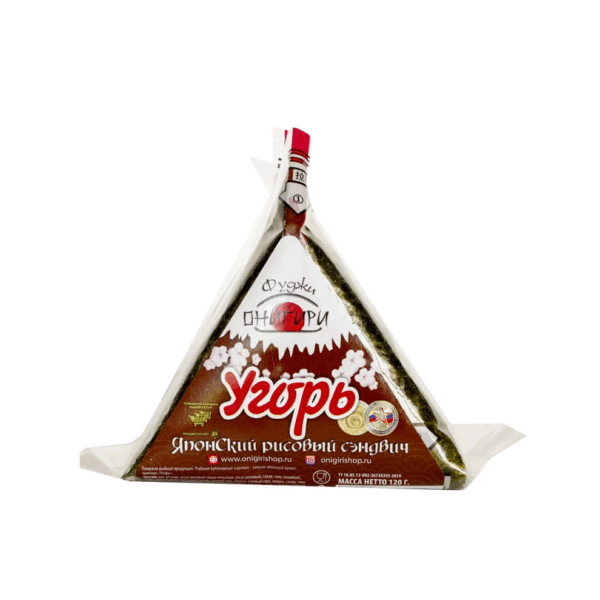
(1) Finished Product Dimensions: Equilateral triangle, side length 90 mm, thickness 22–25 mm
(2) Layer Structure:
- Bottom rice layer: 10–11 mm
- Filling layer (sauce/filling): 2–3 mm
- Top rice layer: 10–11 mm
(3) Filling Weight: Two specifications are available—30 g and 35 g. The filling contains evenly distributed solid particles with an approximate diameter of 5 mm.
(4) Seaweed Wrapping: Nori is wrapped around the surface of the Onigiri before packaging.
(5) Labels: Two labels are applied to each product:
- 137 × 60 mm — Product information label
- 25 × 40 mm — Tamper-evident seal labe

2.2 Process Flow
(1) Rice Elevating and Loosening
- Cooked and seasoned rice is transferred in 10 kg batches to the feeding hopper via an automatic bucket elevator.
- A rice loosening unit gently separates the rice to eliminate clumping, ensuring a uniform texture for subsequent forming and filling processes.
(2) Bottom Rice Layer Forming
- After accurate portioning, the rice enters the forming system, where three bottom Onigiri bases with a central filling cavity are formed simultaneously. The bottom rice layer is controlled at a thickness of 10–11 mm.
- A servo-controlled pressing system ensures consistent forming quality while preserving the natural texture of the rice grains.
(3) Accurate Filling Deposition
- After being continuously stirred to maintain a homogeneous consistency, the filling is accurately deposited into the center cavity of each Onigiri by a rotary pump filling system.
(4) Top Rice Layer Covering and Final Forming
- The top rice layer is delivered through a separate elevating and rice loosening system, then gently pressed onto the filled base.
- The top rice layer is controlled at 10–11 mm. After final pressing, it bonds seamlessly with the bottom layer, resulting in a finished product thickness of 22–25 mm.
(5) Product Conveying and Nori Packaging
- The finished Onigiri is conveyed automatically to the Nori packaging machine.
- Using ultrasonic sealing technology, each Onigiri is securely wrapped inside a pre-made Nori packaging pouch, ensuring a neat appearance and reliable package integrity.
(6) Automatic Labeling
- The packaged products are transferred to the automatic labeling station, where the positioning system automatically detects the package and accurately applies two labels before the finished products are discharged from the production line.
2.3 Process Flow Diagram

III.Complete Line Configuration
3.1 Production Line Layout

3.2 Configuration
(1) Rice Elevator:
The rice elevator is designed to transfer cooked and seasoned rice from the preparation station to the subsequent processing units. A continuous conveying system can elevate approximately 10 kg of rice per batch. All product-contact parts are manufactured from food-grade stainless steel for easy cleaning and hygienic operation. The stable conveying process reduces manual handling while improving the overall efficiency of the production line.
(2) Rice Loosening Machine:
The rice loosening machine uses a rake-type conveyor system to gently separate and loosen the conveyed rice, simulating the manual fluffing process. This prevents rice from clumping and ensures an even distribution of rice grains with a loose and uniform texture. The process is essential for achieving uniform pressure distribution during forming, contributing to consistent product appearance and structural integrity.
(3) Onigiri Forming Machines
The production line is equipped with two independently operated Onigiri forming machines, which work together to complete the entire forming process.
The first forming machine compresses the loosened rice into bottom-layer Onigiri bases with a central filling cavity, providing the structural foundation for the filling process. A servo-controlled pressing module ensures consistent layer thickness while preserving the integrity of the rice grains and maintaining an accurately formed filling cavity.
After filling, the products are transferred automatically to the second forming machine. This machine accurately deposits the top layer of rice and performs a two-stage pressing process to complete the final shaping. Equipped with a servo-controlled pressing system, the machine allows adjustable pressing force to accommodate different rice varieties and texture requirements, ensuring a full appearance, well-defined edges, and stable product structure.
Operating in synchronization, the two forming machines provide coordinated cycle control and multi-stage pressure management, delivering a gentle yet efficient forming process that is particularly suitable for thin Onigiri products with complex structures and high-fluidity fillings.
(4) Filling Machine
The filling machine adopts a rotary pump system specifically designed for high-viscosity and particulate fillings, such as mayonnaise, fish paste, and diced vegetables. It delivers accurate and consistent filling into the bottom rice cavity while maintaining product quality. The machine is mounted on a movable frame, allowing convenient cleaning and rapid filling changeovers to support flexible production.
(5) Onigiri Packaging Machine
The Onigiri packaging machine automatically wraps each formed Onigiri with a pre-made Nori film and completes the sealing process using ultrasonic sealing technology. The machine integrates automatic material feeding, positioning, wrapping, and sealing into a single operation, eliminating manual wrapping while improving package integrity, sealing performance, and overall product consistency.
(6) Labeling Machine
The labeling machine automatically applies two labels to each packaged Onigiri, including the main product label and the tamper-evident seal label. The system supports automatic positioning and label size adjustment, and can be equipped with an optional thermal transfer printing module for printing variable information such as barcodes, QR codes, and production batch numbers. Its high-precision labeling mechanism enhances both product appearance and retail presentation.
(7) Rotary Accumulation Table
Located at the end of the production line, the rotary accumulation table receives the labeled finished products and distributes them evenly for manual or automatic cartoning. Featuring a compact structure and stable operation, the table can be configured to match different production line layouts and operating speeds, serving as an efficient accumulation and transfer station between the automated line and downstream packaging operations.
IV. Advantages and Differentiation
The industrialization of Onigiri production in the Russian market is still at an early stage, with more than 95% of products relying on manual production. Against this backdrop, this solution not only addresses the customer’s immediate needs for higher production capacity and consistent product quality, but also establishes clear competitive advantages through system integration, structural innovation, and flexible equipment design. Compared with conventional production methods and imported equipment, the solution offers greater adaptability, scalability, and long-term operational value.
4.1 Structural Innovation for Customized Product Requirements
To meet the customer’s unique product specifications—a large, thin-profile Onigiri with a 90 mm side length and a finished thickness of 22–25 mm—Resure has developed a dual-stage forming system featuring customized molds, directional filling, a dedicated filling cavity design, and servo-controlled pressing technology. This combination ensures a full product profile while effectively preventing filling leakage during the forming process.
Unlike many imported Onigiri machines that are primarily designed for standard-sized products with fixed molds and limited filling accuracy, this solution provides significantly greater flexibility and precision. By tailoring the forming process to the customer’s specific product structure, it effectively overcomes one of the biggest challenges in Onigiri automation—matching the equipment to non-standard product designs.
4.2 Integrated Automation Platform for Future Growth
Rather than simply replacing individual manual operations, this solution establishes a fully integrated automated production system designed for long-term business growth. Developed and integrated by Resure, the production line features a highly coordinated control architecture, seamless communication between equipment modules, and optimized production flow.
In addition to delivering a stable production capacity of ≥1,500 pieces per hour, the system provides the flexibility required for future product diversification, including different flavors, fillings, and product sizes. Features such as the movable filling unit, quick-cleaning structure, and one-touch recipe management significantly reduce production changeover time, simplify operation and maintenance, and enable the customer to expand efficiently as market demand continues to grow.